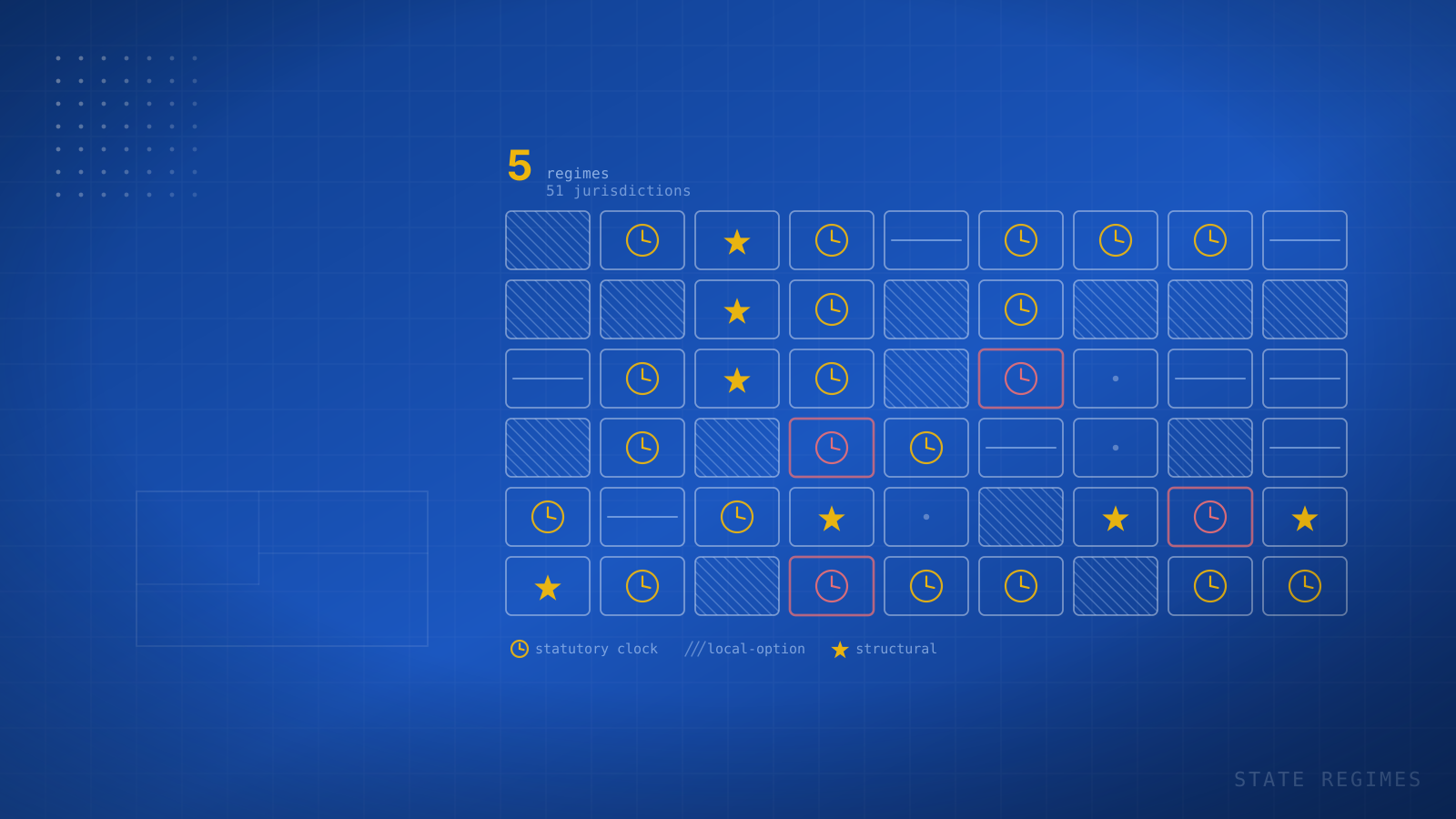
America does not have one building-permit system. It has at least five. We read the governing law for all 50 states plus the District of Columbia and sorted each into a regime. As of 2026, 18 states put a hard decision deadline or a zoning preemption into statute, while 14 leave building codes and timelines almost entirely to local discretion. Where you build determines not just how fast a permit moves, but whether the state promises you any speed at all.
This is Part 1 of The Permitting Map. Every regime and figure links to a Permittable permit guide cited to the official record. Part 2 looks at what cities actually deliver.
Key takeaways
- 18 states now write a building-permit deadline or zoning preemption into law; 14 states leave it to local discretion.
- States fall into five regimes: statutory clock or preemption (18), local-option patchwork (14), mandatory code with no clock (8), structural or special (7), and high-burden framework (4).
- The reform wave is recent, clustered in 2023 to 2026: Texas HB 14, Montana's preemption package, Oregon's 120-day enforcer, and Wyoming's deemed-approved rule.
- A deadline only changes behavior when it carries a remedy: a penalty, a refund, a third-party option, or deemed approval.
- A statutory clock tells you what is promised, not what is delivered, because it starts only after completeness and excludes discretionary review.
Five regimes, not one market
Sorting the 51 jurisdictions by how the state itself structures permitting produces five clear buckets.
The point is not to crown a winner. It is that the same single-family home runs through fundamentally different machinery depending on the state line it sits behind.
The reform wave: clocks with teeth
The most important trend is the rise of the statutory shot clock. Florida is the clearest example of a clock with teeth: the agency must act within a set window, and if it misses, the permit fee is automatically reduced for every business day late. The penalty is what makes the deadline real rather than aspirational.
Others reached for different levers. Texas lets an applicant bring in a qualified third-party reviewer when the local government misses its window (HB 14, 2023). Arizona adds a refund: a city that blows its published time frame must return the review and permit fees. Oregon pairs a long-standing 120-day rule with a new state enforcer. Wyoming's Fast Track Permits Act treats a complete small-home application as deemed approved if the city does not act within 30 days. Georgia, Ohio, Utah, Indiana, Pennsylvania, New Jersey, Michigan, Massachusetts, Connecticut, Rhode Island, and North Carolina all carry their own windows.
One nuance: not every state in this group sets a permit-decision clock. Montana's 2023 housing package preempts local zoning instead, legalizing duplexes and accessory dwelling units by right, and Colorado does the same. They are preemption, not a countdown.
A uniform code is not a fast code
A third group of eight states runs a mandatory uniform statewide code but attaches no statutory speed guarantee. Virginia is the cleanest case: its Uniform Statewide Building Code bars localities from adopting stricter local codes, but there is no statewide shot clock. New York layers a statewide code with a New York City carve-out. Uniformity and speed are different policy levers; a state can guarantee the rules are the same everywhere without guaranteeing that any city moves quickly.
What a clock does and does not buy
The state map tells you what is promised. It does not tell you what is delivered. A decision clock almost always starts only after an application is deemed complete, it usually governs the building permit rather than the discretionary land-use reviews that often precede it, and it is only as strong as its remedy. For what actually gets delivered, you have to drop to the level where permits are issued, measured, and missed: the city and county. That is Part 2: what it actually takes, a measured performance comparison of 118 jurisdictions. Or browse the full permit guide directory to find your state and city.