
Permitting reform has become a national priority, with the U.S. House Committee on Natural Resources actively examining how to modernize and streamline the federal permitting process under the National Environmental Policy Act (NEPA). While much of this work focuses on large-scale federal infrastructure and energy projects, the underlying lessons apply directly to local building permits, zoning approvals, and plan review workflows.
For developers, architects, and builders, the takeaway is simple: permitting delays are rarely about intent or effort. They are usually the result of unclear requirements, fragmented reviews, and incomplete submissions. Federal reform efforts highlight the same structural issues that slow down local approvals, and they point toward practical solutions that project teams can apply today.
Why Permitting Reform Is in the Spotlight
In 2025, the House Committee on Natural Resources made permitting reform a central legislative priority. A key focus has been updating how NEPA reviews are conducted, with bipartisan proposals such as the Standardizing Permitting and Expediting Economic Development (SPEED) Act advancing through committee.
The committee's work reflects broad agreement on several challenges:
- Environmental reviews often take far longer than intended
- Requirements can be unclear or inconsistently applied
- Projects face repeated cycles of review and rework
- Delays increase costs without improving outcomes
These issues have national implications for infrastructure delivery and economic development. They also mirror the exact same friction points that exist in local building permitting across cities and counties.
The Local Permitting Parallel
Most projects submitted through local building departments are not subject to NEPA. However, the mechanics of delay are strikingly similar.
Local permitting slows down when:
- Submission requirements are ambiguous or incomplete
- Architectural, structural, and MEP documents are inconsistent
- Code interpretations surface late in the review process
- Comments arrive in multiple rounds, each triggering redesign
In these cases, the permit fee itself is not the problem. The real cost is time. Carrying costs, extended design hours, and delayed construction schedules quickly compound, especially in high-cost markets.
Permitting reform at the federal level reinforces a core truth: systems fail when they cannot reliably identify a complete and compliant submission early in the process.
What Federal NEPA Reform Teaches Local Project Teams
Federal permitting reform proposals consistently emphasize three themes that translate directly to local approvals.
1. Clear Definitions of Completeness
Federal reforms aim to clarify when NEPA applies and what constitutes sufficient analysis. At the local level, this maps to one of the most common failure points in permitting: unclear or inconsistent completeness standards.
Teams that define and enforce internal completeness checklists reduce the risk of early rejection and late-stage surprises.
2. Fewer Review Loops and Less Rework
A major goal of NEPA reform is to reduce redundant analysis and procedural churn. For local permitting, this means eliminating avoidable resubmittals by resolving conflicts before plans are submitted.
Cross-discipline consistency checks and pre-submission reviews are among the highest leverage actions a team can take.
3. Predictable Timelines
Timeboxing is a recurring theme in federal reform discussions. While local review timelines are often outside an applicant's control, submission quality is not.
High-quality, well-organized permit sets consistently move through review faster than fragmented or incomplete packages.
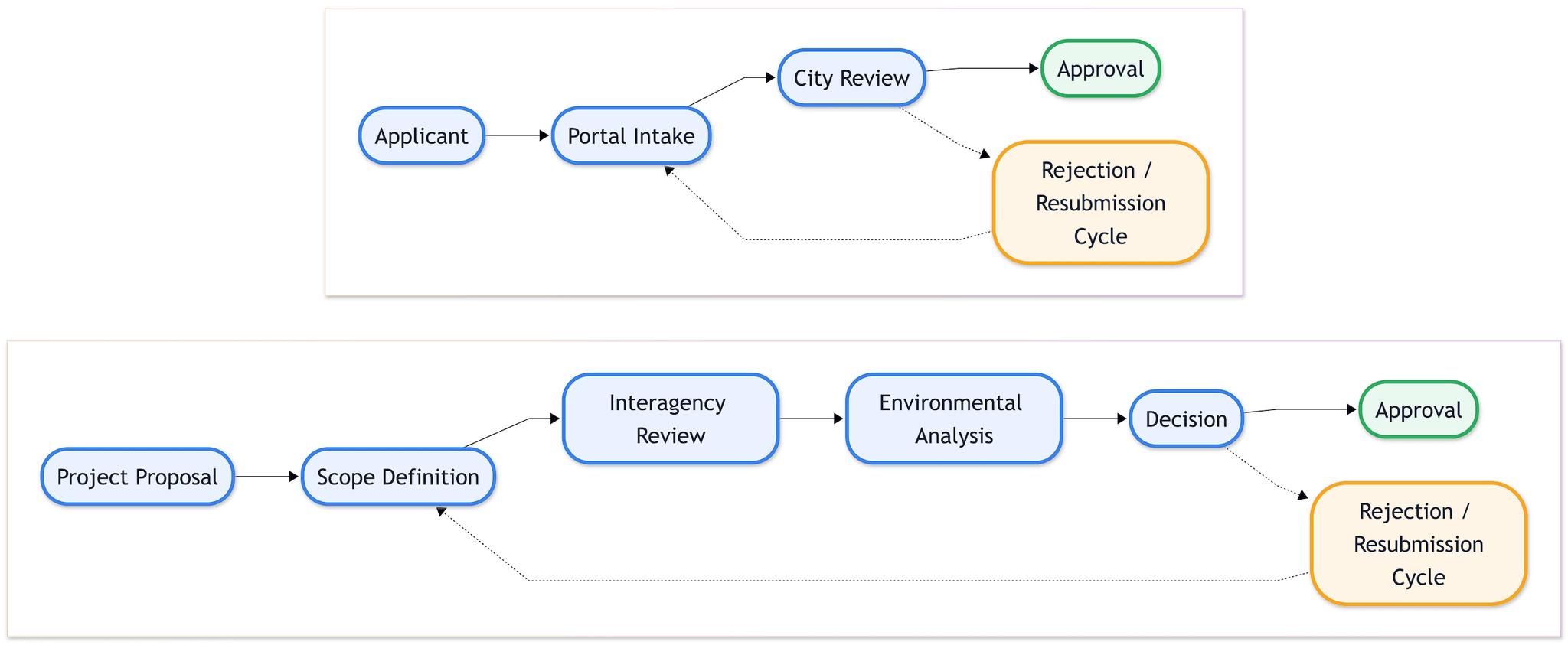
Different scales, same problem. Incomplete information drives delays at every level of permitting.
Where AI and Modern Permitting Tools Fit In
Permitting has become a data-heavy process. Jurisdiction-specific codes, local amendments, and reviewer preferences create complexity that is difficult to manage manually at scale.
AI-assisted permitting tools such as Permittable's solution can help teams:
- Identify missing or inconsistent information before submission
- Cross-check plans against code requirements
- Reduce reviewer back-and-forth by improving first-pass quality
- Create institutional knowledge from past comments and approvals
This approach aligns directly with the goals of permitting reform. Faster approvals are not achieved by cutting corners, but by improving clarity, consistency, and coordination.
The Bottom Line for Developers and Architects
The national conversation around permitting reform exists because delay has real economic consequences. At the local level, those consequences show up as missed schedules, increased carrying costs, and strained project teams.
While federal policy evolves, project teams do not need to wait. The same principles driving national reform can be applied immediately:
- Define what complete and compliant means before submission
- Reduce internal handoffs and inconsistencies
- Treat permit comments as structured feedback, not email threads
- Invest in systems that improve first-time approval rates
Permitting reform is not just a policy discussion. It is a practical blueprint for faster, more predictable approvals at every scale of development.
Applying These Principles Locally
Permittable helps project teams reduce resubmittals and achieve first-time approvals by identifying issues before plans are submitted.