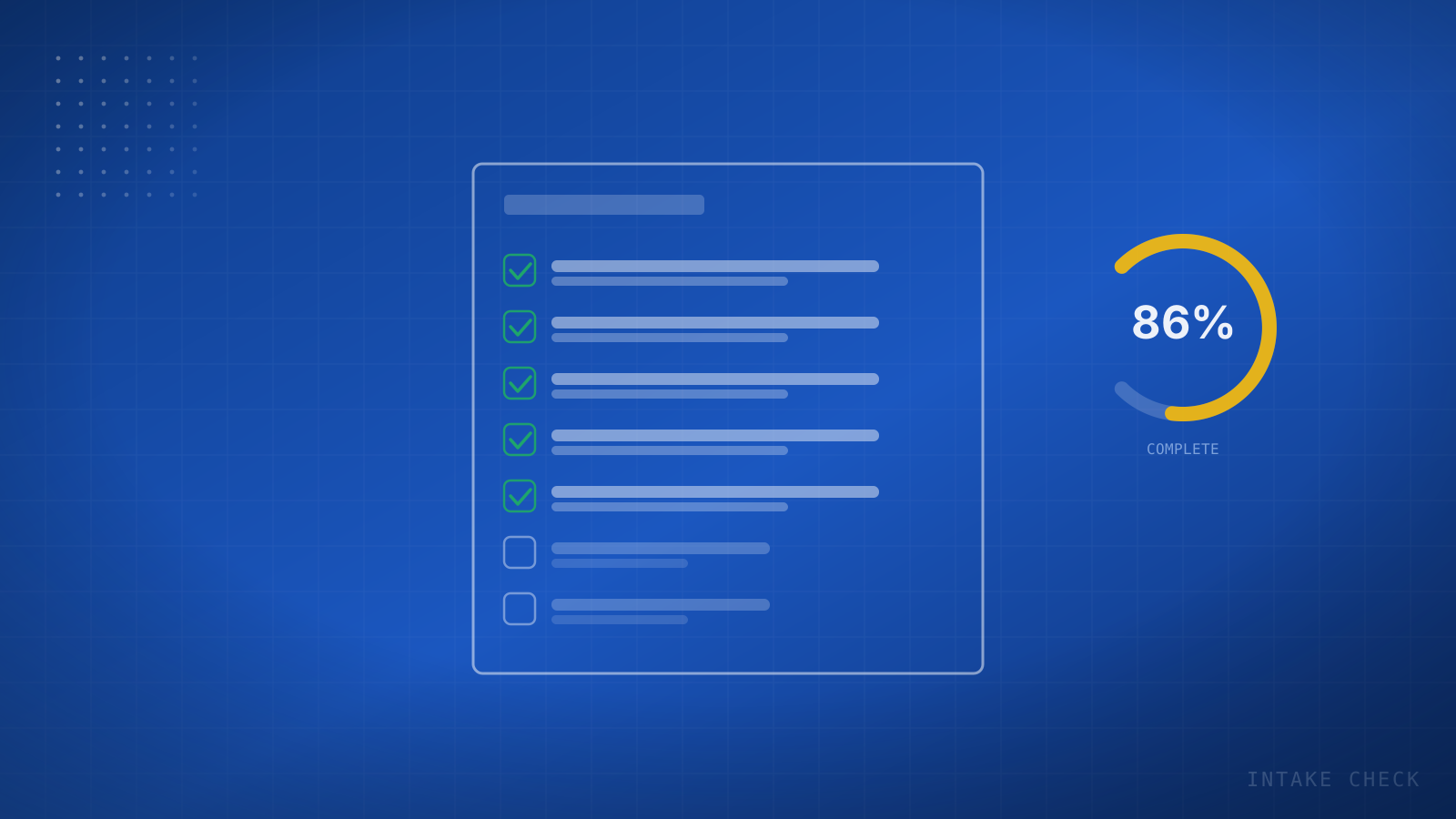
Across the country, cities are overwhelmed - not because projects are becoming radically more complex, but because most permit submittals arrive incomplete, inconsistent, or misaligned with local standards. Building officials will tell you that the majority of delays happen before technical review ever starts.
Several jurisdictions have begun publishing transparent permitting performance reports, making these issues impossible to ignore:
- Washington Department of Commerce now reports end-to-end permit timelines under RCW 36.70B, revealing widespread delays and systemic intake problems.
- San Francisco's Permit Center publishes real-time dashboards showing intake rejections, first-review timelines, and multi-cycle delays.
When planners and reviewers say they are drowning, they're not referring to code research. They're referring primarily to these submittal packages that miss the mark.
The fastest way to shorten a permit timeline isn't arguing code interpretation later - it's sending the city a complete, coordinated package up front.
How Permit Intake Actually Works (and Why Most Applications Fail Here)
Contrary to common belief, your plans don't go straight to a plan reviewer. They first pass through intake technicians who check only for completeness and conformance with required documents. Their job is not technical code review - it's verification.
A typical intake workflow looks like this:
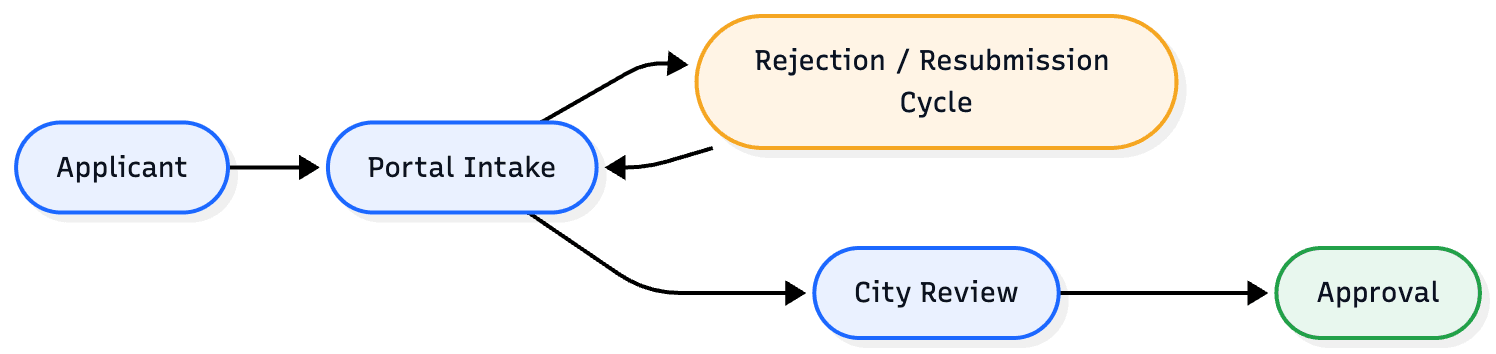
Where delays happen:
- Missing or outdated forms.
- Signatures missing on documents requiring authentication.
- Attachment naming not matching the jurisdiction's checklist.
- Mismatches in project data (square footage, stories, occupancy) across sheets and forms.
Cities consistently report that 40-60% of submissions are incomplete on arrival. (Source: ICC "Digital Permitting Trends", 2023)
That means months of delay can happen before a reviewer ever opens the drawings.
What Cities Say Off the Record: The Submittal Problems That Derail Projects
Below are the issues building departments cite most often - gathered from published permitting guides, state agency reforms, and interviews documented by professional planning organizations:
(Sources include: ICC Digital Permitting Trends Report 2023; WA Commerce 2024 Permit Performance Report; National League of Cities Performance Best Practices)
The most common problems cities complain about:
- Uncoordinated disciplines (architecture vs structural vs MEP).
- Missing or outdated forms.
- Inconsistent project data across cover sheets, SEPA forms, energy forms, and title blocks.
- Energy or structural calculations uploaded without references to drawings.
- Zoning narratives that don't cite actual code sections or jurisdiction amendments.
- Deferred submittals not clearly identified, causing confusion.
- Sheet indexing or naming conventions that do not match city requirements.
These are not complex problems - but they consume enormous city staff time.
The Cost of Sloppy Submittals for Developers
Developers often think, "Worst case, the city will just ask questions." That's not how permitting works.
Every incomplete submittal triggers a full resubmittal round, which can add 30-120 days depending on the jurisdiction.
From Washington Commerce's 2024 report:
| Permit Type | % Over Statute |
|---|---|
| Construction permits | +81% |
| Multifamily (no notice/hearing) | +88% |
| Preliminary subdivisions | +199% |
(Source: Washington Department of Commerce Permit Performance Report 2024)
For developers, this means:
- Carrying costs accumulate.
- Interest on land and construction loans increases.
- Contractor mobilization windows get blown.
- Sales and marketing schedules must shift.
- Pro forma assumptions degrade.
Cities cannot control your internal coordination. But developers can. This is the highest-leverage place to reduce timelines.
What Cities Actually Want From a "Perfect Applicant"
Cities across the country share a consistent expectation: they want permit applications that are complete, coordinated, and easy to verify. When reviewers talk about their ideal applicant, they're describing someone who understands that permitting is fundamentally a communication exercise. The quality of a submittal determines how clearly a reviewer can understand the project without digging through contradictory or incomplete information.
Before any technical evaluation begins, reviewers ask themselves a simple question: Can I trust what I'm looking at? When information conflicts, appears incomplete, or does not align with local amendments, the answer becomes no - and the review stalls. High-quality submittals signal professionalism and reduce the cognitive burden on staff who often process hundreds of applications at once.
1. Complete documentation
Cities expect every required form, study, calculation, and attachment to be present. Missing components aren't viewed as small oversights - they signal that more issues are likely present in the rest of the package.
2. Coherent information
Square footage, occupancy classifications, construction type, height, and energy compliance pathways need to align across all surfaces: drawings, forms, narratives, and calculations. Coherence builds reviewer confidence and reduces the need to cross-verify basic facts.
3. Traceable design decisions
Reviewers want clarity on where design elements are justified. If a calculation or narrative claims code compliance, they want to see the sheet reference. When traceability is strong, reviewers spend less time hunting through drawings.
4. Jurisdiction-specific compliance
Cities expect applicants to demonstrate they understand local amendments, checklists, and intake requirements. Submittals that clearly align with jurisdiction-specific expectations create smoother, faster reviews.
These expectations align with best-practice permitting guidance from:
- National League of Cities "Permit Modernization" Toolkit
- ICC Digital Permitting Framework
A Practical Checklist Developers Should Use Before Every Submittal
Most developers underestimate the importance of a fully coordinated submittal until they get stuck in a multi-month correction loop. Cities consistently report that the majority of delays originate not from deep technical issues, but from avoidable administrative gaps like missing attachments, contradictory data, or discipline conflicts that should have been caught before submission. This section gives developers a practical, city-aligned framework for ensuring that submittals are clean, complete, and ready for review.
Download the Permitting Intake Checklist
We created a concise, jurisdiction-agnostic checklist that helps developers and design teams catch the most common completeness issues before submitting to a city portal. It covers administrative documents, drawing coordination, and technical submittal requirements used by high-performing teams.
Below is a condensed version of what cities wish applicants followed:
Administrative
- All required forms completed and signed.
- Project data matches across every surface.
- All jurisdictions' required attachments included.
Drawings
- Architecture, structural, civil, and MEP aligned.
- Sheet index clean and follows naming conventions.
- Code paths documented (egress, energy, structural system).
Calculations
- Structural, mechanical, and energy calcs reference sheet locations.
- All assumptions documented.
Jurisdiction Standards
- Local amendments reviewed.
- All checklist items verified.
Where AI Help Actually Makes Sense
AI tools are not replacing city reviewers, but they are becoming an important part of improving submittal quality before plans ever reach City Hall. The intake bottleneck is fundamentally a quality control problem, not a code research problem, and AI is uniquely effective at catching exactly the kinds of issues that trigger the first rejection cycle.
A well-implemented AI pre-check can:
- Detect missing or inconsistent documents.
- Validate forms against jurisdiction requirements.
- Flag cross-discipline conflicts between architecture, structural, and MEP.
- Identify likely code issues based on historical comment patterns.
This dramatically reduces the amount of time cities spend on preventable problems and increases the chances that an applicant lands a clean first review cycle.
Multiple governments and organizations have already explored or piloted AI-assisted plan review:
- National Science Foundation and NIST research into automated code checks.
- City- and county-level pilots evaluating AI-supported review workflows.
Visual: Two-Track Workflow
Today:
With Permittable:

Intake Completeness Check
AI analyzes drawings, documents, and forms against city codes, submittal checklists, and common error patterns. This eliminates most issues that trigger the first rejection cycle.
Becoming Your City's Favorite Applicant
Cities do not expect perfection from applicants, but they do expect clarity, consistency, and professionalism. When submittals arrive complete and well-coordinated, the entire permitting process becomes faster and significantly less adversarial. Reviewers can spend their time validating design intent rather than chasing missing documents or resolving cross-discipline conflicts.
Becoming a city's favorite applicant is less about polishing drawings and more about demonstrating you understand how their workflow operates. Cities reward applicants who reduce friction: teams that provide clean, review-ready packages tend to move through the system more predictably, receive fewer correction cycles, and build stronger working relationships with planning staff.
For developers and architects, this creates a competitive advantage. Faster approvals improve project viability, stabilize financing schedules, and reduce soft costs. In an environment where cities are overwhelmed and timelines are under public scrutiny, high-quality submittals directly translate to shorter paths to construction.
Permittable helps teams operate at this level by bringing structure, intelligence, and completeness to each submittal package before it ever reaches the city. When you make life easier for reviewers, they make life easier for you.
If you're ready to reduce delays, improve first-pass outcomes, and give your team an advantage in jurisdictions where timelines are stretching longer every year, we can help. Visit the Solutions page to see how Permittable improves submittal quality, or reach out through our Contact form to discuss your next project and get started.