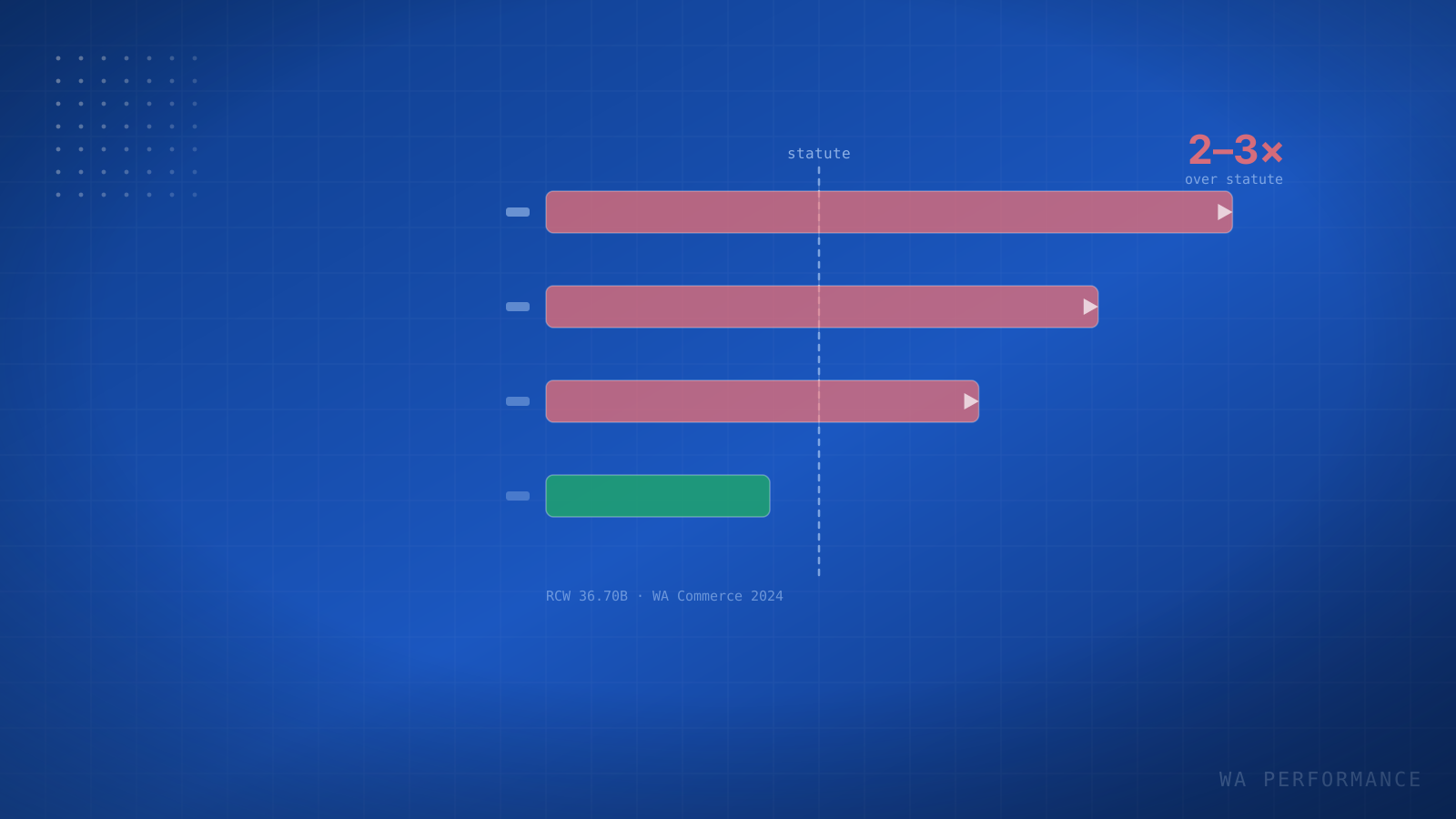
Washington's Department of Commerce released its first full-year permitting performance analysis under RCW 36.70B, and the results tell a clear story: nearly every permit type in the state is taking far longer than intended. In many jurisdictions, review timelines are two to three times longer than statutory expectations.
This brief distills the data and highlights what matters most for cities and developers: why delays happen, where the system breaks down, and where meaningful improvements can occur.
The Big Picture: Washington Is Missing Its Permitting Goals
Across the 2,723 permits reviewed in 2024, the Commerce report shows that nearly every major permit category significantly exceeded its statutory review timeline. These delays are not marginal; they reflect a statewide pattern of structural inefficiency.
Key Data (from Commerce's 2024 report)
| Permit Type | Statutory Target (Days) | Average Actual Review Time (Days) | % Over Statute |
|---|---|---|---|
| Construction Permits | 120 | 217 | +81% |
| Binding Site Plans | 45 | 24 | -46% (faster than statute) |
| Multifamily (No Notice, No Hearing) | 120 | 226 | +88% |
| Multifamily (Notice, No Hearing) | 150 | 250 | +67% |
| Multifamily (Notice + Hearing) | 180 | 218 | +21% |
| Preliminary Subdivisions | 90 | 269 | +199% |
| Final Subdivisions | 30 | 85 | +184% |
What You Need to Know
The Commerce findings make the scale of delay visually unmistakable. The chart derived from the 2024 report shows how far actual review times deviate from statutory expectations across permit types. Construction and multifamily permits consistently exceed targets by wide margins, while only binding site plans come in below statute. For developers, this translates to unpredictable timelines and financing exposure. For cities, it highlights systemic intake and process challenges that slow projects long before technical review begins.
Variance Between Jurisdictions Means No Predictability
Even when looking at the same permit type, timelines vary dramatically between Washington jurisdictions. This isn't a small spread; it's the difference between a system that functions and one that leaves applicants stalled for months.
Jurisdiction Deadline Variance (Recreated from Commerce's 2024 Report)
| Permit Type | Average Variance vs. Statute | Jurisdictions With Highest Variances | How Much Longer These Jurisdictions Allow |
|---|---|---|---|
| Construction Permit | 33.29 days greater | Kirkland, Edmonds, Tumwater | 665 days, 475 days, 115 days greater |
| Binding Site Plan | 2.15 days less | Auburn, Kent, Everett, Olympia | 55 days greater (all) |
| Multifamily No Notice, No Hearing | 14.54 days greater | Bainbridge Island | 175 days greater |
| Multifamily Notice, No Hearing | 33.29 days greater | Bainbridge Island | 185 days greater |
| Multifamily Notice + Hearing | 10.67 days greater | Bainbridge Island | 145 days greater |
| Preliminary Subdivisions | 13.79 days greater | Bothell, Issaquah, Kenmore, Sammamish, Kitsap County, Edmonds | 80-90 days greater |
| Final Subdivisions | 15.93 days greater | Camas, Auburn, Kenmore | 90-140 days greater |
What This Means for Developers and Cities
Washington's permitting system doesn't just run long; it runs inconsistently. A construction permit in one jurisdiction may be reviewed within a quarter, while the same permit type in another city may drift nearly two years past the statutory expectation.
For developers, this inconsistency makes planning extremely difficult. Financing schedules, contractor mobilization, land carrying costs, and sales projections all depend on predictable timelines. When jurisdictions differ by hundreds of days, predictability disappears.
For cities, these large variances create reputational and political risk. Commerce's reporting is now public, making comparisons between peer jurisdictions unavoidable. Cities that lag behind stand out immediately.
 Variance in permit review timelines across Washington jurisdictions - Source: Washington Department of Commerce 2024 Report
Why Is This Happening
Commerce attributes delays not to regulatory complexity but to workflow friction, especially at the intake stage, before technical review begins.
Identified Sources of Delay
- Incomplete or inconsistent applications that trigger repeated correction cycles.
- Manual intake and validation processes, even within digital portals.
- Limited staff capacity and turnover that amplify each resubmittal.
- Fragmented routing between departments.
- Pause-clock mechanics that obscure true calendar time.
- Jurisdictions extending their own review deadlines due to systemic overload.
Workflow Today (High Friction)
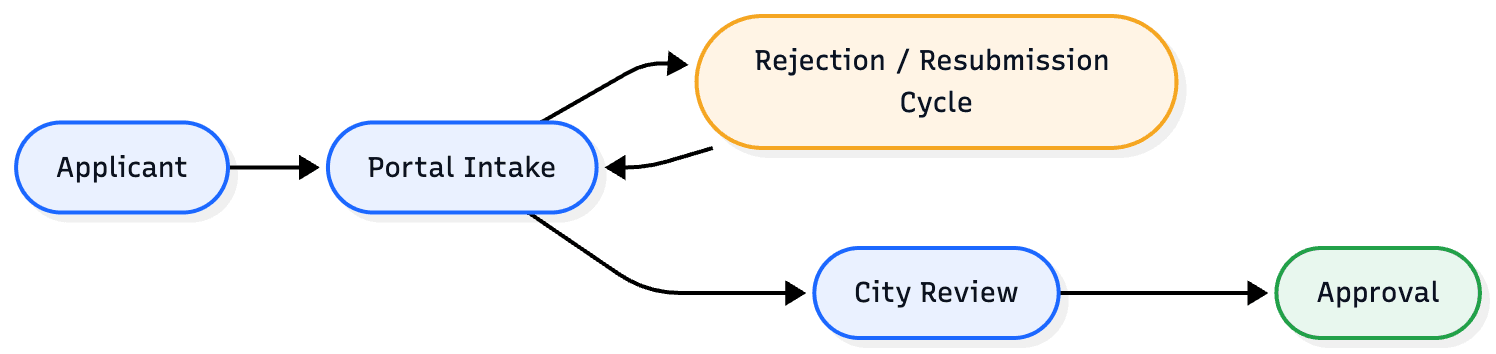 Current high-friction permitting workflow with rejection and resubmission cycles
The core issue: cities are overwhelmed validating submissions, not performing technical review.
This Initial Report Is a Wakeup Call
For developers, the biggest threat to project timelines isn't regulatory nuance but preventable friction caused by incomplete or inaccurate submissions.
Most delays occur before substantive review even begins. A single missing document or inconsistent sheet can trigger multiple rejection cycles and pause-clock resets, extending a project by months.
Developers who control the quality of their initial submissions — ensuring completeness, consistency, and alignment with local requirements — can bypass the majority of delays. Clean first submissions dramatically improve predictability, reduce holding costs, and increase the likelihood of meeting financing and construction milestones.
For cities, the report makes internal gaps visible. Transparency requirements expose true cycle times, highlighting where processes struggle.
But cities also gain a roadmap: improving the quality of incoming submissions is the most impactful way to reduce delays. Stronger intake standards, clearer expectations, and tools that help applicants get submissions right the first time can significantly reduce administrative burden.
Cities don't necessarily need more staff; they need better inputs.
How Permittable Delivers the Solution
Permittable is built to address the structural issues highlighted in the Commerce report: incomplete submissions, rejection cycles, administrative churn, and inconsistent application quality.
Permit Readiness Checks
AI analyzes drawings, documents, and forms against city codes, submittal checklists, and common error patterns. This eliminates most issues that trigger the first rejection cycle.
First-Pass Permit Reviews
Permittable performs a structured technical review prior to submission. This increases the likelihood of a clean first pass, the strongest predictor of shorter timelines.
Standardized Packaging
Submittals are organized, named, cross-referenced, and formatted to match each city's intake requirements.
City-Side Acceleration (Optional)
Cities can use Permittable as an internal reviewer assistant, improving consistency and throughput without adding headcount.
Workflow With Permittable (Reduced Friction)
 Permittable-powered workflow with pre-check before portal intake, eliminating rejection cycles
Permittable reduces rejections, pauses, and resubmittal cycles by addressing issues before an application reaches the city.
Intake Completeness Check
AI analyzes drawings, documents, and forms against city codes, submittal checklists, and common error patterns. This eliminates most issues that trigger the first rejection cycle.
A Final Thought
Washington's 2024 Commerce report makes a central point clear: permitting delays stem primarily from process and completeness issues, not from complex regulations. Cities can't simply hire their way out of the gap, and developers cannot afford unpredictable timelines.
Improving accuracy and completeness at the front end is the highest-impact step both sides can take.
For the jurisdiction-by-jurisdiction numbers behind this analysis, see our Washington permit timelines guide.
Permittable is built to make that step achievable. Reach out to get started with faster permitting.